
How AI works
What it is
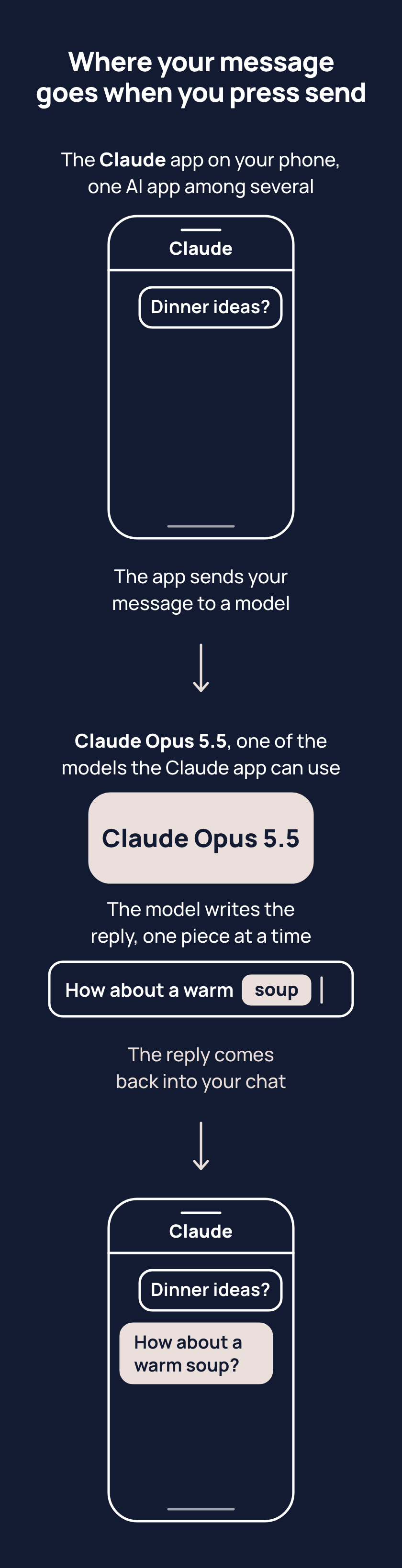
ChatGPT, Claude, Gemini and Copilot are AI apps: what you open and type into. The app does not write the reply. It sends your message to a separate program, called a model, which writes the reply. The model runs on computers elsewhere, not on your phone. ChatGPT uses a model called GPT-6, and the Claude app can use one called Claude Opus 5.5.
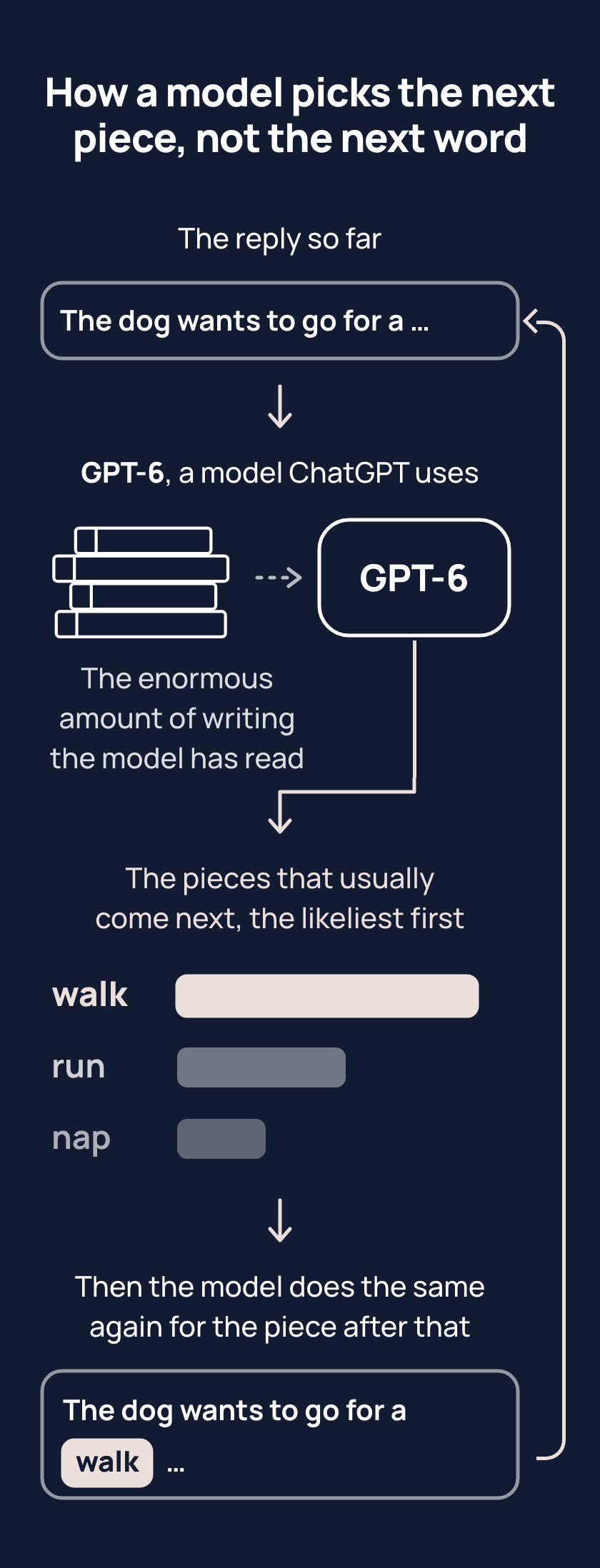
Before a model is used, the company that built it makes it read an enormous amount of writing. A model writes in pieces called tokens, often part of a word. For each piece, the model looks at the chat so far. Then it asks one question: from everything it learned in all that reading, which piece usually comes after the words in the chat so far? It then picks a likely piece. Usually that is the likeliest, but not always, so the same question from you, asked twice, can get two different replies. With "The dog wants to go for a", the likeliest piece is "walk", though a model might sometimes pick "run".
Nothing checks whether the reply is true, so a wrong one reads like a right one. When a model writes that it is not sure, the model wrote those words the same way as every other word. It did not go and check anything. Some apps also search the web, and say so.
Tips
- Before you trust a fact, look for a line saying your AI app searched or links to sources. Without that sign, do not assume the answer was checked against anything, so treat it as a draft because that is what the model makes.
- Treat a confident answer as a first draft to check, because a model writes a wrong answer in exactly the same tone as a right one.
Try it
- In your AI app, open a fresh chat and ask about something from this week, adding "do not search".
- Open another fresh chat, ask the same thing, and add "search the web".
- Compare the two replies and look for a line saying the app searched, or links to sources.
A reply with that sign is one the app looked up. A reply without the sign is one the model wrote from its reading alone. If the first chat shows the sign too, the app decided to search on its own, and the sign still tells you what the app did.
Risks
- When you give your AI app a link, the model can write about the page without the app opening it. Look for the sign that the app opened the page. Without the sign, open the page and paste the part you want into the chat.
- A reply saying "I checked", "I searched" or "I am not sure" is the model's words, written like every other word, and is not the sign that the app searched. Trust the app's line or links on the screen, not the reply's claim about itself.
Why it matters
Once you know a model writes the likeliest next piece rather than checking the facts, a confident answer stops counting as proof. Fluent writing is just what a model makes, right or wrong, so you check the fact, not the tone.